






Article: Cologne pots

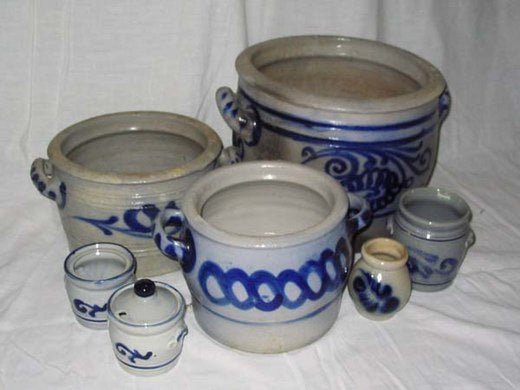
Cologne pots
Origin of Cologne stoneware pots
The name doesn't literally refer to the city of Cologne, but in the Netherlands, it's used for German stoneware from production areas like Westerwald, Siegburg, Raeren, and Frechen. Westerwald, in particular, grew into an important center for stoneware intended for the Dutch market in the 18th and 19th centuries.
How to recognize Cologne stoneware pots?
Material
- Grey stoneware
- Hard and high-fired
- Exceptionally durable
Salt glaze
Cologne stoneware pots often have a slightly glossy surface due to the use of salt glaze. During the firing process, salt was added to the kiln, making the pottery watertight and suitable for storing food and liquids.
Cobalt blue decoration
Early examples from around 1800–1860 often feature cobalt blue decorations. Think of stylized plants, animals, or simple ornaments, which today are an important identifying feature for collectors.
Functional forms
- Anchovy pots
- Mustard pots
- Storage jars
- Jugs for drinks or vinegar
Usage in the Netherlands
In the Netherlands, Cologne stoneware pots were used for storing fish and anchovies, mustard, preserves, butter, margarine, and spirits. Traders from Westerwald themselves traveled to the Netherlands, which led to these pots becoming widely distributed here and a familiar part of daily use.
Dating & value
What to look for?
- Blue decoration, especially on early pots
- Stamps or markings
- Quality of the glaze
- Chips, restorations, or hairline cracks
- Size, as larger pots are often rarer
Value factors
- Age
- Condition
- Rarity of decoration or inscription
- Regional or trade-related variants
Why Cologne stoneware pots remain popular
Cologne stoneware pots remain beloved for their historical value, timeless appearance, and robust material use. They are simple in form but strong in character, forming a tangible connection between daily use, traditional craftsmanship, and 19th-century trade history.
View more Cologne stoneware pots

Written by Rémon van den Kommer