
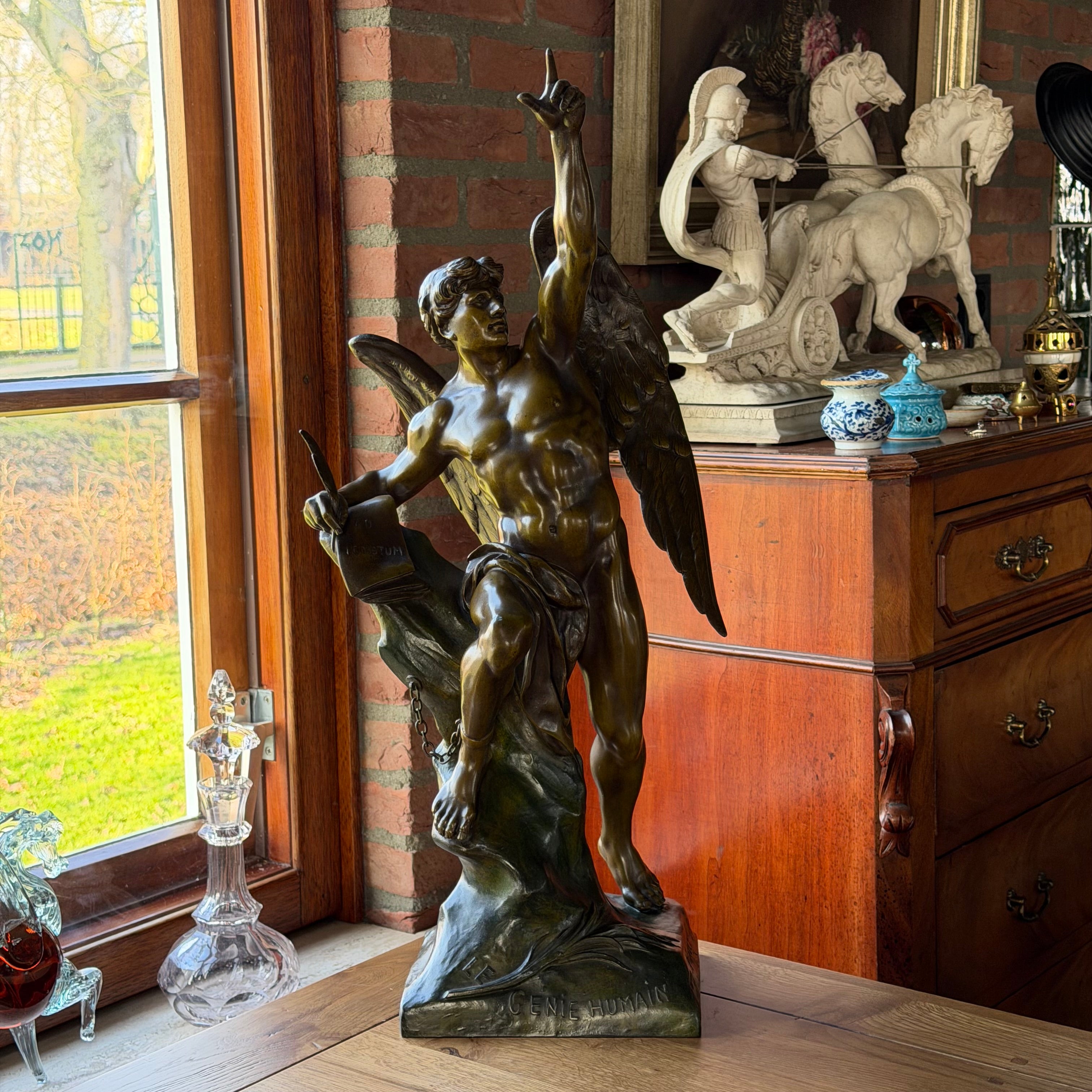


Monumental French Sculpture 'Génie Humain' – after Émile Picault, Parisian Casting ca. 1900
This monumental sculpture, titled Génie Humain , depicts the human spirit at its most ambitious: writing, reaching out, and aiming for the unknown. The tense posture and anatomical precision make this not a decorative angelic figure, but an allegory of intellect, progress, and human willpower. The Latin inscription Ad Ignotum – "towards the unknown" – underscores this meaning.
The design is by Émile Picault , a leading French sculptor of the fin de siècle, known for his allegorical sculptures that center on knowledge, science, and human aspiration. His works were created not only for museums but also for the private homes of thinkers, academics, and collectors around 1900.
This example was cast in France and bears the original Parisian foundry mark , Fabrication Française – Paris , as well as the title Génie Humain and the name E. Picault in the casting. The natural, deeply developed patina reveals not a modern finish, but a gradual aging consistent with an early 20th-century casting. Its weight and detailing give the sculpture a physical presence that instantly defines the space in which it stands.
This isn't an object that disappears into an interior. It's an anchor piece that carries meaning without needing explanation.
Dimensions: 68.5 cm high
Weight: 7607 grams
About authenticity, casting and material
This statue is not a unique author's copy , but a historical, legitimate casting based on an original design by Émile Picault . His sculptures were repeatedly cast during and shortly after his active period, often by French foundries using the same molds and official hallmarks.
Based on style, patina, marks, and execution, this example can be placed around the turn of the century (ca. 1895–1910) . There is no evidence of a modern decorative reproduction: the statue has the correct weight, a complex patina, and cast inscriptions, with no contemporary markings.
The material is bronze or heavy régule with bronze patina , as is common in French sculptures from this period. This type of work is internationally accepted and traded in the market as an old edition after Picault , which is both historically accurate and collectible.
Choose options